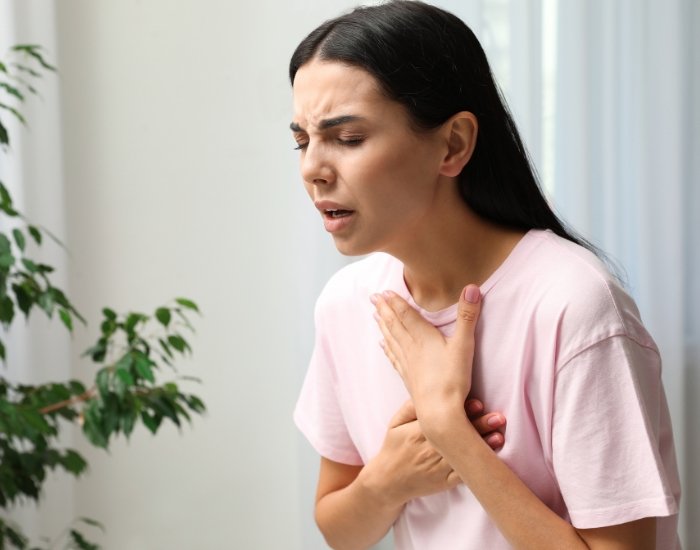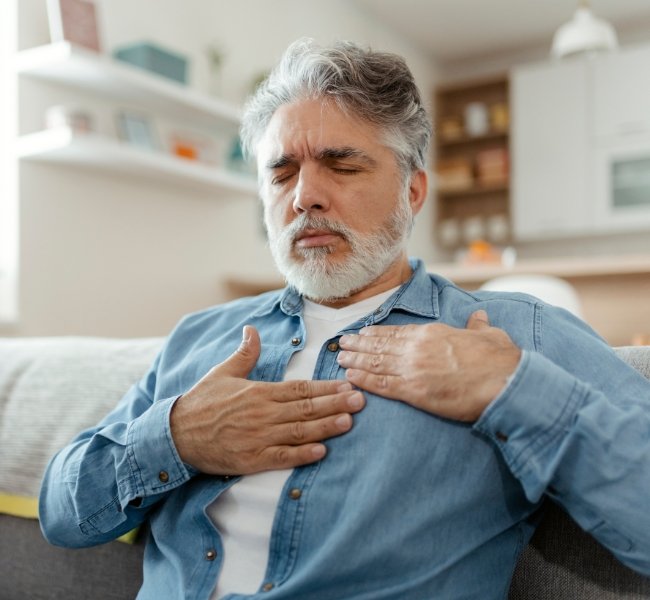
Chest pain is one of the most common reasons adults seek emergency care, and with good reason. It can come from the heart, lungs, esophagus, muscles, nerves or even anxiety. Some causes are minor; others, such as a heart attack, aortic dissection or blood clot in the lung, are emergencies where minutes matter.
You cannot always tell the cause from the feeling alone, but certain features make a serious cause more or less likely. This guide gives a practical way to decide what to do when chest pain catches your attention: call 911, get seen the same day, or book a cardiology visit.
Quick answer
Call 911 for chest pain or pressure that lasts more than a few minutes, comes on at rest, spreads to the arm, jaw, neck or back, or comes with shortness of breath, sweating, nausea, fainting or a racing heartbeat; also for sudden tearing pain or chest pain with sudden breathlessness. Get seen the same day for new chest pain that comes with exertion and goes away with rest. Brief, sharp pain that changes with touch, movement or position, with no other symptoms, is less likely to be cardiac but should still be checked if it persists or recurs.
Have symptoms you want checked? Dr. M. Usman Khan sees patients at our Northwest Houston, Tomball and Sugar Land offices.
What patients say about our care team
Read all reviews on Google- ★★★★★
The staff was amazing, very friendly and attentive.
— Stephanie G. Google review - ★★★★★
He explained everything to me!
— Yesenia B. Google review - ★★★★★
Everyone is incredibly supportive and the standard of care is top tier.
— Humzah A. Google review - ★★★★★
It's always good when someone cares, not just comes to work.
— Cecila A. Google review - ★★★★★
I felt like I waited less time and was seen much faster!
— Yesenia B. Google review
- ★★★★★
I am extremely grateful for the support and compassion.
— Debra L. W. Google review - ★★★★★
She always takes great care of me.
— Shemeanna B. Google review - ★★★★★
Her clinical skills were exemplary. I would definitely recommend.
— Humzah A. Google review - ★★★★★
I had a great experience with my appointment today.
— Stephanie G. Google review - ★★★★★
Mrs. Maxine literally listened to my concerns.
— Cecila A. Google review
Important
If in doubt, call 911. Do not drive yourself to the hospital with chest pain.
How Do You Decide How Urgent Chest Pain Is?
Think in three levels: emergency (call 911), urgent (same-day evaluation) and routine (scheduled visit), based on how the pain started, how long it lasts and what comes with it.
| Level | Features | Action |
|---|---|---|
| Emergency | Pressure lasting minutes, at rest, with sweating, breathlessness, nausea, fainting; tearing pain; pain with sudden breathlessness | Call 911 |
| Urgent | New pressure with exertion that eases with rest; worsening pattern of known angina | Same-day medical evaluation |
| Routine | Brief sharp pain reproduced by pressing or movement; pain clearly tied to meals or reflux; no other symptoms | Schedule a visit; seek care if it changes |
Which Heart Causes Produce Chest Pain?
Heart attack, unstable and stable angina, pericarditis, myocarditis, aortic dissection, aortic stenosis and hypertrophic cardiomyopathy.
- Angina and heart attack: pressure or tightness, often spreading, triggered by exertion or at rest.
- Pericarditis: sharp pain worse lying flat and better sitting forward.
- Aortic dissection: sudden severe tearing pain radiating to the back.
- Valve disease: exertional pain with breathlessness or fainting.
See symptoms of blocked heart arteries.
When to seek care right away
Call 911 for:
- Chest pressure lasting more than a few minutes
- Chest pain with sweating, nausea or breathlessness
- Sudden tearing pain to the back
- Chest pain with sudden shortness of breath or fainting
Call your doctor the same day for:
- New chest discomfort with exertion
- Angina becoming more frequent
- Chest pain after a recent ER visit with unclear cause
- Chest pain with multiple risk factors
What Non-Heart Causes Are Common?
Acid reflux, esophageal spasm, muscle strain, costochondritis, gallbladder disease, pneumonia, pleurisy, pulmonary embolism, shingles and panic attacks.
Pulmonary embolism, a blood clot in the lung, causes sudden sharp pain with breathlessness and is an emergency. See is chest pain always a heart attack and chest pain when breathing deeply.
What Clues Help Distinguish Heart From Non-Heart Pain?
Heart pain is usually pressure-like, diffuse, triggered by exertion and accompanied by other symptoms; non-heart pain is more often sharp, localized, reproducible with touch, or clearly tied to meals, breathing or position.
| Feature | More likely heart | Less likely heart |
|---|---|---|
| Quality | Pressure, squeezing, heaviness | Sharp, stabbing, fleeting |
| Location | Diffuse, center or left chest | Pinpoint spot |
| Trigger | Exertion, stress, cold | Touch, twisting, swallowing |
| Duration | Minutes | Seconds or many hours unchanged |
| Other symptoms | Sweating, breathlessness, nausea | None |
These are guides, not rules. People with diabetes, women and older adults often have atypical symptoms.
What Will Doctors Check in the Emergency Department?
An ECG within minutes, blood tests for troponin (a heart muscle injury marker), a chest X-ray, and depending on findings, CT scans, echocardiography or observation with repeat testing.
High-sensitivity troponin testing allows many patients to have a heart attack ruled out within a few hours.
When Should You See a Cardiologist?
After an emergency visit for chest pain, for chest discomfort with exertion, for chest pain with risk factors such as diabetes, high blood pressure, high cholesterol or smoking, or when the cause remains unclear.
A cardiologist may order a stress echocardiogram, nuclear stress test, coronary CT or calcium score. See chest pain evaluation.
What Should You Do While Waiting for Help?
Stop activity, sit down, chew one regular aspirin if a dispatcher advises and you are not allergic, take prescribed nitroglycerin, unlock the door and have your medicine list ready.
If the person becomes unresponsive and is not breathing normally, start CPR and use an AED.
Why Do Risk Factors Change How Chest Pain Is Treated?
The same symptom carries very different meaning in a healthy 25-year-old than in a 60-year-old smoker with diabetes; doctors combine symptoms with age, sex and risk factors to estimate the chance of a heart cause and choose tests.
Clinicians often use structured scores that weigh history, ECG, age, risk factors and troponin to decide who can safely go home and who needs further testing or admission. People at low risk with normal tests can usually be followed up as outpatients, while intermediate-risk patients may need a stress test or coronary CT within days.
Keeping a chest pain diary
If you have recurring chest discomfort, write down when it happens, what you were doing, how long it lasted, what it felt like and what relieved it. This simple record often helps your cardiologist pinpoint the cause much faster.
What Should You Do After an ER Visit for Chest Pain?
Follow up with your primary doctor or a cardiologist within a few days to a week, complete any recommended stress test or imaging, review medicines, and return immediately if pain recurs or worsens.
- Bring your discharge papers, ECG and lab results to the follow-up visit.
- Ask whether a heart cause was ruled out or just made less likely.
- Clarify which symptoms should send you back to the ER.
- Start any prescribed medicines, such as aspirin or a statin, as directed.
- Address risk factors: blood pressure, cholesterol, diabetes and smoking.
Chest pain in younger adults
Heart attacks are less common under 40 but do occur, especially with smoking, diabetes, very high cholesterol, family history, cocaine or stimulant use, or after childbirth. Myocarditis, sometimes after viral infections, and pericarditis also cause chest pain in younger people. Do not dismiss symptoms because of age.
Is It Safe to Wait and See if Chest Pain Goes Away?
No, if the pain has emergency features; heart muscle is lost every minute an artery stays blocked, and many people who die of heart attacks delay calling for help.
Emergency teams would much rather evaluate chest pain that turns out to be harmless than see someone too late.
Does Relief From Nitroglycerin or Antacids Tell You the Cause?
Not reliably. Nitroglycerin can relax the esophagus and ease reflux or spasm, and antacids can seem to help heart pain by coincidence, so response to either should not be used to rule out a heart cause.
Let testing, not a home remedy, decide.
Where to See a Cardiologist in Houston
Epic Heart & Vascular Center evaluates heart and vascular symptoms at three Greater Houston offices, with many tests such as ECGs and echocardiograms available on site. Care is led by Dr. M. Usman Khan, MD, FACC.
Also serving Richmond, Spring, Kingwood, Willowbrook and Eldridge patients. Monday to Friday, 8:00 am to 5:00 pm.
Key Takeaways
- Chest pain can come from the heart, lungs, esophagus, muscles or nerves.
- Pressure lasting minutes, at rest or with other symptoms needs 911.
- New chest discomfort with exertion needs same-day evaluation.
- ECG and troponin tests quickly assess heart causes.
- A cardiologist can find the cause when it remains unclear.
Frequently Asked Questions
When should I go to the ER for chest pain?
For pressure lasting minutes, pain at rest, or pain with sweating, breathlessness, nausea, fainting or spreading to the arm or jaw.
How do I know if chest pain is my heart?
Heart pain is usually pressure-like, triggered by exertion and accompanied by other symptoms, but only testing can confirm.
Can anxiety cause chest pain?
Yes, but heart causes should be ruled out first, especially with risk factors.
Is sharp chest pain a heart attack?
It is less typical, but pericarditis, pulmonary embolism and aortic dissection can cause sharp pain.
What tests check chest pain?
ECG, troponin blood test, chest X-ray, and stress testing or CT as needed.
Should I take aspirin for chest pain?
Only if a 911 dispatcher or doctor advises and you are not allergic.
Sources and Further Reading
- MedlinePlus. Chest pain.
- National Heart, Lung, and Blood Institute. Heart Attack.
- Gulati M, et al. 2021 AHA/ACC Guideline for the Evaluation and Diagnosis of Chest Pain. PubMed.
- MedlinePlus. Pulmonary embolus.
Medical disclaimer: This article is for general education and does not replace a visit with your own doctor. Symptoms, test results and treatment choices differ from person to person.
Please note: Reading this article does not create a doctor–patient relationship. If you think you are having a medical emergency, call 911.

About our cardiology practice
Dr. M. Usman Khan, MD, FACC
Dr. Khan is an interventional and general cardiologist who leads care at Epic Heart & Vascular Center, with offices in Northwest Houston, Tomball and Sugar Land. He completed his cardiovascular fellowship at the University of Virginia and holds fellowships in the American College of Cardiology, the American College of Physicians, the Society for Cardiovascular Angiography and Interventions and the American Society of Nuclear Cardiology.
This guide was written by the Epic Heart & Vascular Center editorial team from the sources listed above. Meet Dr. Khan →
Related Articles

Is Chest Pain Always a Sign of a Heart Attack? Common Non-Heart Causes
Most chest pain is not a heart attack. Learn the common non-heart causes, from muscle strain and reflux to lung and anxiety-related…

Chest Pain That Radiates to the Arm and Back: Is It Heart-Related?
Chest pain spreading to the arm or back can signal a heart attack, angina or aortic dissection, but it can also come…
Heart Attack vs Heartburn: Here’s How to Tell Them Apart
Heartburn and heart attack can both cause burning chest discomfort. Learn the differences in triggers, timing and accompanying symptoms, the red flags…