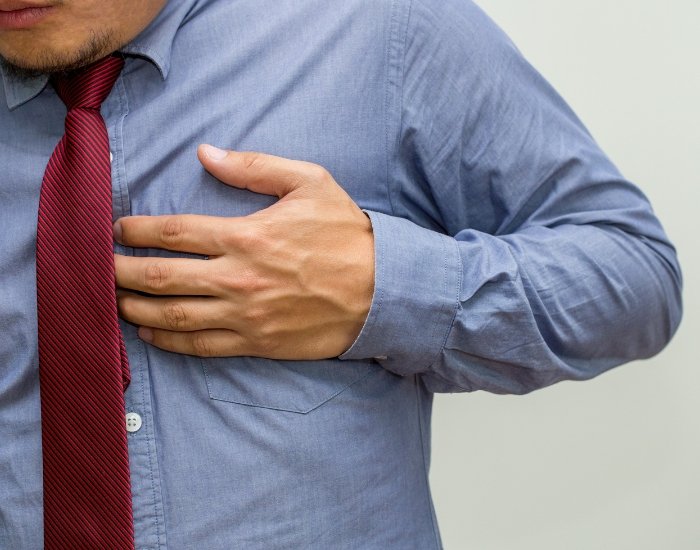
Early heart failure rarely announces itself. There is usually no single dramatic moment. Instead, people notice that the stairs feel steeper than they did last spring, that their shoes are tight by evening, or that they now sleep propped up on two pillows without quite knowing why. Because these changes creep in slowly, they are easy to blame on age, weight or a busy schedule.
This guide explains what heart failure actually feels like in its early stages, which warning signs deserve a call to a cardiologist, which ones need 911, and how doctors confirm the diagnosis. Catching heart failure early matters: today’s treatments work best when they are started before the heart muscle is badly weakened.
Quick answer
Early heart failure usually feels like getting out of breath more easily, tiring faster than usual, and noticing swelling in the feet, ankles or belly. Many people also have trouble breathing when lying flat, a lingering cough, or sudden weight gain from fluid (more than 2–3 pounds in a day or 5 pounds in a week). These symptoms are common and have many causes, so the only way to know is a heart evaluation that usually includes an echocardiogram and a blood test called BNP or NT-proBNP.
Noticing new breathlessness, swelling or fatigue? Dr. M. Usman Khan sees patients at our Northwest Houston, Tomball and Sugar Land offices.
What patients say about our care team
Read all reviews on Google- ★★★★★
The staff was amazing, very friendly and attentive.
— Stephanie G. Google review - ★★★★★
He explained everything to me!
— Yesenia B. Google review - ★★★★★
Everyone is incredibly supportive and the standard of care is top tier.
— Humzah A. Google review - ★★★★★
It's always good when someone cares, not just comes to work.
— Cecila A. Google review - ★★★★★
I felt like I waited less time and was seen much faster!
— Yesenia B. Google review
- ★★★★★
I am extremely grateful for the support and compassion.
— Debra L. W. Google review - ★★★★★
She always takes great care of me.
— Shemeanna B. Google review - ★★★★★
Her clinical skills were exemplary. I would definitely recommend.
— Humzah A. Google review - ★★★★★
I had a great experience with my appointment today.
— Stephanie G. Google review - ★★★★★
Mrs. Maxine literally listened to my concerns.
— Cecila A. Google review
Important
This article is general education, not a diagnosis. If you have chest pain or pressure, severe shortness of breath, fainting, or coughing up pink, foamy mucus, call 911 now.
What Does Heart Failure Feel Like in the Early Stages?
In the early stages, heart failure feels less like a heart problem and more like a slow loss of stamina: you get winded sooner, tire faster and may notice puffiness in your lower legs.
Heart failure does not mean the heart has stopped. It means the heart is not pumping or filling as well as the body needs. When that happens, two things follow. Less oxygen-rich blood reaches your muscles, which is why you feel drained. And blood backs up in the veins, so fluid leaks into the lungs, legs and abdomen, which is why you feel short of breath and swollen.
Patients often describe the early phase in very ordinary terms:
- “I used to walk the dog around the block without stopping. Now I need a break halfway.”
- “My socks leave deep marks on my ankles at night.”
- “I wake up feeling like I can’t catch my breath and have to sit up.”
- “I’m eating less, but the scale keeps going up.”
None of these alone proves heart failure. Together, and especially if they are new or getting worse, they are a reason to see a cardiologist.
What Are the Early Warning Signs of Heart Failure?
The eight most common early warning signs are breathlessness with activity, trouble breathing when lying flat, swelling, rapid weight gain, unusual fatigue, a persistent cough, loss of appetite and a racing or irregular heartbeat.
1. Getting out of breath during everyday activity
Shortness of breath with exertion is often the first symptom people notice. The key word is change: if carrying groceries, climbing one flight of stairs or walking across a parking lot now leaves you winded when it did not a few months ago, take note.
2. Trouble breathing when lying flat or waking up breathless
When you lie down, fluid shifts from the legs back toward the chest. A weak heart cannot move that extra volume, so the lungs become congested. Doctors call breathlessness lying flat orthopnea, and sudden waking at night gasping for air paroxysmal nocturnal dyspnea. Needing more pillows to sleep comfortably is a classic clue.
3. Swelling in the feet, ankles, legs or belly
Fluid retention, called edema, usually shows up first around the ankles and is worse at the end of the day. Pressing on the skin may leave a dent. Some people notice their waistband getting tighter or a full, bloated feeling in the abdomen instead.
4. Rapid weight gain
Weight that climbs quickly is almost always fluid, not fat. The American Heart Association advises calling your doctor for a gain of more than 2 to 3 pounds in 24 hours or 5 pounds in a week. Weighing yourself every morning, after using the bathroom and before breakfast, is one of the simplest ways to catch heart failure early.
5. Fatigue and weakness
When the heart cannot meet the body’s demand, blood is diverted away from the muscles toward vital organs. The result is a heavy, all-day tiredness that rest does not fully fix and that makes ordinary tasks feel like work.
6. A cough or wheezing that will not go away
Fluid in the lungs can cause a dry, hacking cough or wheezing that is easily mistaken for allergies, bronchitis or asthma. A cough that brings up pink or foamy mucus is an emergency.
7. Loss of appetite or feeling full quickly
Congestion in the liver and digestive tract can cause nausea, a poor appetite or feeling full after a few bites. It is one of the most commonly overlooked symptoms.
8. A racing or irregular heartbeat
The heart may speed up to make up for weaker pumping, and heart failure often occurs together with atrial fibrillation. Palpitations that last, keep coming back, or come with dizziness should be checked. Learn more about atrial fibrillation and arrhythmia care.
Why Does Heart Failure Cause These Symptoms?
The symptoms come from two problems: the heart pumps out too little blood, and blood backs up behind it, pushing fluid into the lungs and tissues.
Cardiologists classify heart failure by the ejection fraction, the share of blood the left ventricle pushes out with each beat, measured on an echocardiogram. The type matters because treatment differs.
| Type | Ejection fraction | What it means |
|---|---|---|
| HFrEF (reduced) | 40% or less | The heart muscle is weakened and does not squeeze well. |
| HFmrEF (mildly reduced) | 41% to 49% | Pumping is mildly reduced; often treated similarly to HFrEF. |
| HFpEF (preserved) | 50% or more | The heart squeezes normally but is stiff and does not fill well. |
Heart failure can also affect mainly the right side of the heart, causing more leg and abdominal swelling. Read more about right-sided heart failure and diastolic heart failure.
Who Is Most at Risk for Heart Failure?
People with high blood pressure, coronary artery disease or a prior heart attack, diabetes, obesity, kidney disease or valve disease have the highest risk, and the risk rises with age.
Heart failure is far from rare. About 6.7 million American adults live with it, and the Heart Failure Society of America estimates that roughly one in four people will develop it during their lifetime. The most important risk factors are:
- High blood pressure that has been elevated for years. See our high blood pressure treatment page.
- Coronary artery disease or a previous heart attack, which can scar the heart muscle. Learn about coronary artery disease care.
- Diabetes, obesity and chronic kidney disease.
- Heart valve disease and long-standing rhythm problems such as atrial fibrillation.
- Family history of cardiomyopathy, and past chemotherapy or radiation to the chest.
- Heavy alcohol use, smoking and sleep apnea.
When to seek care right away
Call 911 for:
- Chest pain, pressure or tightness
- Severe shortness of breath, or breathlessness at rest
- Fainting or nearly fainting
- Coughing up pink, foamy mucus
- A racing heartbeat with dizziness or confusion
Call your doctor the same day for:
- Weight gain of more than 2–3 pounds in a day or 5 pounds in a week
- New or worsening swelling in the legs or belly
- Needing more pillows to breathe at night
- Breathlessness with less activity than usual
Is It Heart Failure or Something Else?
Many of these symptoms have other causes, such as lung disease, anemia, thyroid problems, kidney disease, medications or poor sleep, which is why testing is needed.
| Symptom | Points more toward heart failure | Other common causes |
|---|---|---|
| Shortness of breath | Worse lying flat, with swelling or weight gain | Asthma, COPD, anemia, deconditioning |
| Leg swelling | Both legs, with breathlessness | Vein problems, medications, long sitting, a clot (usually one leg) |
| Fatigue | Together with reduced exercise tolerance | Anemia, thyroid disease, depression, poor sleep |
| Cough | Worse at night or lying down | Allergies, reflux, infection, some blood pressure pills |
Sudden, painful swelling of only one leg can be a blood clot and needs same-day care.
How Do Cardiologists Diagnose Early Heart Failure?
Diagnosis combines your history and exam with an echocardiogram, a BNP or NT-proBNP blood test and an ECG, plus other tests when needed.
- Echocardiogram: an ultrasound that measures ejection fraction, valve function and heart size. See echocardiography and Doppler studies.
- BNP or NT-proBNP blood test: these hormones rise when the heart is under strain and help separate heart failure from lung causes of breathlessness.
- Electrocardiogram (ECG): checks rhythm and signs of a past heart attack. See ECG testing.
- Stress testing or nuclear imaging: looks for blocked arteries as a cause. See nuclear cardiac testing.
- Blood work: kidney function, blood count, thyroid and blood sugar.
Under the 2022 AHA/ACC/HFSA guideline, heart failure is described in stages. Stage A means you are at risk, Stage B means the heart shows changes but you have no symptoms yet, Stage C means symptoms are present, and Stage D is advanced disease. The goal of early evaluation is to find people in Stages A and B, or early C, when treatment can change the course.
Can Early Heart Failure Be Treated?
Yes. Medicines, treatment of the underlying cause and daily habits can ease symptoms, keep people out of the hospital and, in many cases, help the heart recover strength.
For heart failure with reduced ejection fraction, current guidelines recommend a combination of four medicine groups, often called guideline-directed medical therapy, which have been shown to lower the risk of hospitalization and death. Diuretics (water pills) relieve fluid buildup. Your cardiologist also treats what caused the heart failure, such as blocked arteries, high blood pressure or an irregular rhythm.
- Weigh yourself every morning and keep a log.
- Limit sodium as your care team advises, and read food labels.
- Take medicines exactly as prescribed, even when you feel well.
- Stay active within your limits; a cardiac rehabilitation program can help.
- Keep blood pressure, blood sugar and cholesterol under control, and stop smoking.
Find out more on our heart failure care page.
Where to See a Cardiologist in Houston
If you have any early warning signs of heart failure, Epic Heart & Vascular Center can evaluate you at three Greater Houston offices, with many tests such as echocardiograms and ECGs available on site. Care is led by Dr. M. Usman Khan, MD, FACC.
Also serving Richmond, Spring, Kingwood, Willowbrook and Eldridge patients. Monday to Friday, 8:00 am to 5:00 pm.
Key Takeaways
- Early heart failure often feels like losing stamina: breathlessness with activity, fatigue and swelling.
- Trouble breathing when lying flat and rapid weight gain (2–3 pounds in a day or 5 in a week) are important early clues.
- About 6.7 million U.S. adults have heart failure, and high blood pressure, coronary disease, diabetes and obesity raise the risk.
- An echocardiogram and a BNP or NT-proBNP blood test are central to the diagnosis.
- Treatment started early can relieve symptoms, prevent hospital stays and sometimes help the heart recover.
- Chest pain, severe breathlessness, fainting or pink frothy mucus need 911.
Frequently Asked Questions
What is usually the first sign of heart failure?
For many people, the first sign is getting short of breath during activities that used to be easy, often together with tiredness or ankle swelling.
Can you have heart failure and not know it?
Yes. In Stage B, the heart already shows changes on an echocardiogram but there are no symptoms. Early symptoms are also easy to blame on age or weight, which is why at-risk people benefit from a check-up.
How much weight gain is a warning sign of heart failure?
The American Heart Association advises contacting your doctor if you gain more than 2 to 3 pounds in a day or 5 pounds in a week, because sudden gain usually means fluid buildup.
What test confirms heart failure?
There is no single test. An echocardiogram to measure how the heart pumps and fills, and a BNP or NT-proBNP blood test, are the most important, along with your history, exam and an ECG.
Is early heart failure reversible?
Sometimes. When the cause is treated, such as high blood pressure, a rhythm problem or a blocked artery, and modern medicines are started early, heart function can improve. Even when it cannot fully recover, treatment helps people feel better and live longer.
Where can I see a cardiologist for heart failure symptoms in Houston?
Epic Heart & Vascular Center sees patients at Northwest Houston (Red Oak Drive), Tomball and Sugar Land / Greatwood. Call (832) 432-1951 or request an appointment online.
Sources and Further Reading
- American Heart Association. Warning Signs of Heart Failure.
- American Heart Association. Managing Heart Failure Symptoms.
- National Heart, Lung, and Blood Institute. Heart Failure: Symptoms.
- Heidenreich PA, et al. 2022 AHA/ACC/HFSA Guideline for the Management of Heart Failure. Circulation. 2022.
- Heart Failure Society of America. HF Stats 2025: Heart Failure Epidemiology and Outcomes Statistics.
- Centers for Disease Control and Prevention. About Heart Failure.
Medical disclaimer: This article is for general education and does not replace a visit with your own doctor. Symptoms, test results and treatment choices differ from person to person.
Please note: Reading this article does not create a doctor–patient relationship. If you think you are having a medical emergency, call 911.

About our cardiology practice
Dr. M. Usman Khan, MD, FACC
Dr. Khan is an interventional and general cardiologist who leads care at Epic Heart & Vascular Center, with offices in Northwest Houston, Tomball and Sugar Land. He completed his cardiovascular fellowship at the University of Virginia and holds fellowships in the American College of Cardiology, the American College of Physicians, the Society for Cardiovascular Angiography and Interventions and the American Society of Nuclear Cardiology.
This guide was written by the Epic Heart & Vascular Center editorial team from the sources listed above. Meet Dr. Khan →