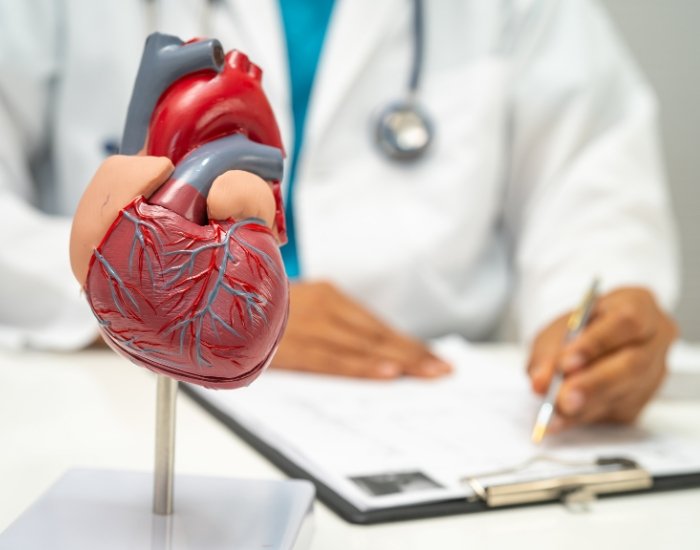
The heart has two pumping sides. The left side sends oxygen-rich blood to the body; the right side sends oxygen-poor blood to the lungs. When the right side cannot keep up, blood backs up into the veins of the body, causing swelling in the legs and abdomen, a congested liver and fatigue. This is right-sided heart failure, sometimes called right ventricular failure or, when caused by lung disease, cor pulmonale.
Right-sided heart failure rarely appears out of nowhere. It is usually the result of another condition, most often left-sided heart failure, chronic lung disease or high pressure in the lung arteries. Understanding the cause is essential, because treatment depends on it. This guide explains how right-sided heart failure develops, how it feels, how it is diagnosed and how it is treated.
Quick answer
Right-sided heart failure occurs when the right ventricle cannot pump blood efficiently into the lungs, so blood backs up into the body’s veins. The most common cause is left-sided heart failure; others include pulmonary hypertension, chronic lung disease such as COPD, blood clots in the lungs, right ventricular heart attacks and valve disease. Typical symptoms are swelling of the legs, ankles and abdomen, rapid weight gain, fatigue, shortness of breath and a full, aching feeling under the right ribs. Treatment combines diuretics, treatment of the underlying cause and careful monitoring.
Have symptoms you want checked? Dr. M. Usman Khan sees patients at our Northwest Houston, Tomball and Sugar Land offices.
What patients say about our care team
Read all reviews on Google- ★★★★★
The staff was amazing, very friendly and attentive.
— Stephanie G. Google review - ★★★★★
He explained everything to me!
— Yesenia B. Google review - ★★★★★
Everyone is incredibly supportive and the standard of care is top tier.
— Humzah A. Google review - ★★★★★
It's always good when someone cares, not just comes to work.
— Cecila A. Google review - ★★★★★
I felt like I waited less time and was seen much faster!
— Yesenia B. Google review
- ★★★★★
I am extremely grateful for the support and compassion.
— Debra L. W. Google review - ★★★★★
She always takes great care of me.
— Shemeanna B. Google review - ★★★★★
Her clinical skills were exemplary. I would definitely recommend.
— Humzah A. Google review - ★★★★★
I had a great experience with my appointment today.
— Stephanie G. Google review - ★★★★★
Mrs. Maxine literally listened to my concerns.
— Cecila A. Google review
Important
Sudden severe shortness of breath, chest pain, fainting or coughing up blood can signal a blood clot in the lungs, which can cause acute right heart failure. Call 911.
How Does Right-Sided Heart Failure Develop?
It develops when the right ventricle is overwhelmed by high pressure in the lungs, too much volume, or damage to its own muscle, so it cannot move blood forward into the lungs.
The right ventricle is a thinner-walled chamber built to pump against low pressure. When pressure in the lung circulation rises, for example from a failing left heart or lung disease, the right ventricle must work much harder. Over time it enlarges and weakens. Blood then backs up into the right atrium and the large veins, raising venous pressure throughout the body and pushing fluid into the tissues.
What Causes Right-Sided Heart Failure?
The leading cause is left-sided heart failure; others include pulmonary arterial hypertension, chronic lung disease, pulmonary embolism, right ventricular heart attack, valve disease, congenital heart disease and sleep apnea.
- Left-sided heart failure: pressure backs up from the left heart through the lungs to the right ventricle. See early signs of heart failure.
- Pulmonary hypertension: high pressure in the lung arteries from many causes.
- Chronic lung disease (cor pulmonale): COPD, pulmonary fibrosis and others that lower oxygen and raise lung pressures.
- Pulmonary embolism: large or repeated clots in the lungs.
- Right ventricular heart attack: usually with blockage of the right coronary artery.
- Valve disease: tricuspid regurgitation or pulmonary valve problems.
- Congenital heart disease such as atrial septal defects.
- Obstructive sleep apnea: repeated low oxygen raises lung pressures.
What Are the Symptoms of Right-Sided Heart Failure?
Symptoms include swelling of the feet, ankles, legs and abdomen, rapid weight gain, fatigue, shortness of breath with exertion, a full or aching feeling under the right ribs, poor appetite, nausea and swollen neck veins.
| Symptom | Why it happens |
|---|---|
| Leg and ankle swelling | High venous pressure pushes fluid into tissues |
| Abdominal swelling (ascites) | Fluid collects in the abdomen |
| Ache under the right ribs | The liver becomes congested and stretched |
| Poor appetite, nausea, early fullness | The gut and liver are congested |
| Fatigue and weakness | Reduced blood flow to muscles |
| Shortness of breath | Often from the underlying left heart or lung disease |
| Rapid weight gain | Fluid retention |
| Bulging neck veins | Raised pressure in the right atrium |
How Is Right-Sided Heart Failure Different From Left-Sided?
Left-sided failure mainly causes fluid in the lungs and breathlessness, while right-sided failure mainly causes fluid in the legs, abdomen and liver; many people have both.
In left-sided failure, people often feel breathless lying flat and may wake up gasping. In right-sided failure, swelling and abdominal fullness dominate. Because left-sided failure is the most common cause of right-sided failure, both patterns frequently coexist. Read about diastolic heart failure and heart failure guidelines.
When to seek care right away
Call 911 for:
- Sudden severe shortness of breath
- Chest pain or coughing up blood
- Fainting
- Confusion or very low blood pressure
Call your doctor the same day for:
- Rapid weight gain
- Worsening leg or abdominal swelling
- Increasing fatigue or poor appetite
- Breathlessness with less activity
How Is Right-Sided Heart Failure Diagnosed?
Diagnosis relies on an echocardiogram to assess the right ventricle and estimate lung pressures, along with ECG, BNP blood test, chest imaging, lung tests and sometimes right heart catheterization.
- Echocardiogram: right ventricle size and function, tricuspid valve and estimated pulmonary pressure.
- BNP or NT-proBNP: rises with heart strain.
- ECG: right heart strain patterns, rhythm problems.
- Chest X-ray or CT: lung disease or clots.
- Pulmonary function tests and sleep study.
- Right heart catheterization: directly measures pressures when pulmonary hypertension is suspected.
How Is Right-Sided Heart Failure Treated?
Treatment targets the cause and relieves fluid overload: diuretics, guideline-directed therapy for left heart failure, oxygen and treatment of lung disease, blood thinners for clots, pulmonary hypertension medicines, valve repair and treatment of sleep apnea.
- Diuretics to remove excess fluid and relieve swelling.
- Treatment of left heart failure with proven medicines. See heart failure care.
- Oxygen and lung disease management when oxygen levels are low.
- Anticoagulation for pulmonary embolism.
- Pulmonary arterial hypertension medicines in selected patients.
- Valve repair or replacement when indicated.
- CPAP for sleep apnea.
What Can You Do to Manage Right-Sided Heart Failure at Home?
Weigh yourself daily, limit sodium, follow any fluid limits, take medicines as prescribed, elevate your legs, stay active within your limits and report rapid weight gain or worsening swelling.
- Weigh every morning; report a gain of more than 2 to 3 pounds in a day or 5 pounds in a week.
- Limit sodium and follow fluid guidance from your care team.
- Elevate your legs when sitting.
- Avoid NSAIDs, which cause fluid retention.
- Stay active with walking or a rehab program.
- Do not smoke, and get flu, pneumonia and COVID-19 vaccines.
What Is the Outlook for Right-Sided Heart Failure?
The outlook depends mostly on the underlying cause and how well it responds to treatment; when left heart failure, sleep apnea, clots or valve disease are treated effectively, right heart function often stabilizes or improves.
Right-sided heart failure caused by a single treatable event, such as a pulmonary embolism, may improve substantially once the clot resolves. When it is driven by left heart failure, modern medicines that strengthen the left ventricle and lower filling pressures also relieve the right side. Advanced lung disease and severe pulmonary arterial hypertension tend to be more challenging, though newer therapies have improved survival and quality of life.
Signs your condition is getting worse
- Weight gain despite taking diuretics
- Swelling moving higher up the legs or into the abdomen
- Needing to sleep sitting up
- Feeling full after only a few bites
- Dizziness or low blood pressure, especially after medicine changes
- New irregular heartbeat or palpitations
Contact your cardiology team early when these appear. Small adjustments in diuretic dose or other medicines, made promptly, often prevent a hospital stay.
How Can You Live Well With Right-Sided Heart Failure?
Stay active within your limits, keep regular follow-up, monitor weight daily, manage sodium and fluids, and involve family in your care plan.
Cardiac rehabilitation programs teach safe exercise and self-care skills and improve stamina. See cardiac rehabilitation. Ask your care team for a written action plan that tells you what to do when weight or symptoms change.
Where to See a Cardiologist in Houston
Epic Heart & Vascular Center evaluates heart and vascular symptoms at three Greater Houston offices, with many tests such as ECGs and echocardiograms available on site. Care is led by Dr. M. Usman Khan, MD, FACC.
Also serving Richmond, Spring, Kingwood, Willowbrook and Eldridge patients. Monday to Friday, 8:00 am to 5:00 pm.
Key Takeaways
- Right-sided heart failure means the right ventricle cannot pump blood to the lungs effectively.
- Left heart failure, lung disease, pulmonary hypertension and lung clots are the main causes.
- Swelling of the legs and abdomen, liver congestion and weight gain are typical symptoms.
- An echocardiogram and BNP test are central to diagnosis.
- Treatment combines diuretics with treatment of the underlying cause.
Frequently Asked Questions
What is right-sided heart failure?
A condition in which the right ventricle cannot pump blood to the lungs efficiently, causing blood and fluid to back up into the body.
What is the most common cause of right-sided heart failure?
Left-sided heart failure. Lung disease and pulmonary hypertension are other common causes.
What are the symptoms of right-sided heart failure?
Leg, ankle and abdominal swelling, weight gain, fatigue, an ache under the right ribs, poor appetite and shortness of breath.
Can right-sided heart failure be treated?
Yes. Diuretics relieve swelling, and treating the underlying cause can stabilize or improve the condition.
What is cor pulmonale?
Right-sided heart failure caused by lung disease or low oxygen levels.
Is right-sided heart failure life threatening?
It can be serious, especially if the cause is not treated, but many people live for years with good management.
Sources and Further Reading
- National Heart, Lung, and Blood Institute. Heart Failure.
- National Heart, Lung, and Blood Institute. Pulmonary Hypertension.
- MedlinePlus. Cor pulmonale.
- MedlinePlus. Heart Failure.
Medical disclaimer: This article is for general education and does not replace a visit with your own doctor. Symptoms, test results and treatment choices differ from person to person.
Please note: Reading this article does not create a doctor–patient relationship. If you think you are having a medical emergency, call 911.

About our cardiology practice
Dr. M. Usman Khan, MD, FACC
Dr. Khan is an interventional and general cardiologist who leads care at Epic Heart & Vascular Center, with offices in Northwest Houston, Tomball and Sugar Land. He completed his cardiovascular fellowship at the University of Virginia and holds fellowships in the American College of Cardiology, the American College of Physicians, the Society for Cardiovascular Angiography and Interventions and the American Society of Nuclear Cardiology.
This guide was written by the Epic Heart & Vascular Center editorial team from the sources listed above. Meet Dr. Khan →
Related Articles
Early Signs of Heart Failure: What It Feels Like in the Early Stages
Early heart failure often feels like getting winded sooner, tiring faster and noticing swelling. Learn the 8 warning signs, when to call…
All You Need to Know About Diastolic Heart Failure (HFpEF)
Diastolic heart failure, or heart failure with preserved ejection fraction, happens when a stiff heart cannot fill properly. Learn the causes, symptoms,…
Heart Failure Guidelines: What the Latest Recommendations Mean for Patients
Current heart failure guidelines describe stages A to D, four foundational medicines for reduced ejection fraction, SGLT2 inhibitors for most types, devices…