You get into bed, the house goes quiet, and suddenly you are aware of every beat: a steady thump in your chest, a pulse in your ear against the pillow, or a beat that seems to skip just as you drift off. For many people this is unsettling enough to keep them awake.
In most cases, noticing your heartbeat at night is normal. Lying down changes how blood returns to the heart, the room is quiet, and you are paying attention. But palpitations that are fast, irregular, or come with breathlessness or dizziness can point to a rhythm problem or another condition worth treating. Here is how to tell the difference.
Quick answer
Feeling your heartbeat when lying down is usually normal: in that position more blood returns to the heart, the heart sits closer to the chest wall (especially on your left side), and a quiet room makes each beat easier to notice. It deserves a medical check if the beat is fast, irregular or pounding, if it comes with shortness of breath, chest pressure, dizziness or fainting, or if it wakes you up. A cardiologist can usually find the cause with an ECG and a heart monitor.
Have symptoms you want checked? Dr. M. Usman Khan sees patients at our Northwest Houston, Tomball and Sugar Land offices.
What patients say about our care team
Read all reviews on Google- ★★★★★
The staff was amazing, very friendly and attentive.
— Stephanie G. Google review - ★★★★★
He explained everything to me!
— Yesenia B. Google review - ★★★★★
Everyone is incredibly supportive and the standard of care is top tier.
— Humzah A. Google review - ★★★★★
It's always good when someone cares, not just comes to work.
— Cecila A. Google review - ★★★★★
I felt like I waited less time and was seen much faster!
— Yesenia B. Google review
- ★★★★★
I am extremely grateful for the support and compassion.
— Debra L. W. Google review - ★★★★★
She always takes great care of me.
— Shemeanna B. Google review - ★★★★★
Her clinical skills were exemplary. I would definitely recommend.
— Humzah A. Google review - ★★★★★
I had a great experience with my appointment today.
— Stephanie G. Google review - ★★★★★
Mrs. Maxine literally listened to my concerns.
— Cecila A. Google review
Important
Call 911 if a racing or irregular heartbeat comes with chest pain, severe shortness of breath, fainting or confusion.
Why Do I Feel My Heartbeat More When Lying Down?
Lying down increases blood return to the heart, brings the heart closer to the chest wall and removes the background noise that normally masks your heartbeat.
When you stand, gravity pools some blood in your legs. When you lie flat, that blood flows back toward the chest, so the heart fills a little more and each beat is slightly stronger. Lying on your left side moves the heart closer to the ribs, which is why many people notice it most in that position. And at night there is nothing to distract you, so your brain registers sensations it ignores all day.
Pressing your ear against a pillow can also let you hear the pulse in the arteries of your neck and ear, a sound called pulsatile awareness. On its own, it is not a sign of disease.
When Is It Normal and When Is It Not?
It is usually normal if the beat is regular, at a normal rate (about 60 to 100 beats per minute at rest) and you have no other symptoms; it is not normal if it is fast, irregular, very slow, or comes with other symptoms.
| Feature | Usually harmless | Needs a check |
|---|---|---|
| Rhythm | Steady and regular | Irregular, skipping often, chaotic |
| Rate at rest | 60–100 beats per minute | Above 100 or below 50 with symptoms |
| Onset | Gradual, only when you notice it | Sudden start and stop, wakes you up |
| Other symptoms | None | Breathlessness, chest pressure, dizziness, fainting |
| Triggers | Lying on left side, after exercise | Happens night after night without a reason |
An easy home check: place two fingers on your wrist or neck and count for 30 seconds, then double it. Note whether the beat is regular. Many smartwatches can also record a single-lead ECG that you can show your doctor.
What Causes Palpitations at Night?
Common causes include extra heartbeats, caffeine, alcohol, nicotine, stress and anxiety, dehydration, anemia, thyroid problems, fever, pregnancy, certain medicines and heart rhythm disorders.
Everyday triggers
- Caffeine, energy drinks or chocolate late in the day
- Alcohol, especially binge drinking (sometimes called holiday heart)
- Nicotine and vaping
- Large or late meals, which can trigger extra beats in some people
- Decongestants, asthma inhalers, thyroid medicine and some supplements
- Stress, anxiety and lying awake worrying
- Dehydration and low potassium or magnesium
Medical causes
- Premature beats (PACs and PVCs): a skip followed by a stronger thump.
- Atrial fibrillation: a fast, irregular fluttering that can start at rest or at night.
- Supraventricular tachycardia (SVT): a sudden racing beat that starts and stops abruptly.
- Overactive thyroid, anemia, fever or pregnancy: all make the heart beat faster and harder.
- Sleep apnea: drops in oxygen during sleep trigger surges of adrenaline and rhythm problems.
- Heart failure or valve disease: can cause pounding beats and breathlessness when lying flat.
What if I Am Also Short of Breath Lying Down?
Breathlessness when lying flat, needing extra pillows or waking up gasping are warning signs of heart failure or fluid in the lungs and need prompt evaluation.
When a weakened heart cannot handle the extra blood returning from the legs at night, fluid backs up into the lungs. Patients sit up to breathe easier, start sleeping on two or three pillows, or wake up suddenly short of breath. Combined with a pounding heartbeat, ankle swelling or rapid weight gain, this pattern needs a cardiologist soon. Read about the early signs of heart failure and shortness of breath when lying down.
When to seek care right away
Call 911 for:
- Racing or irregular heartbeat with chest pain or pressure
- Severe shortness of breath or gasping
- Fainting or nearly fainting
- Confusion or weakness on one side
Call your doctor the same day for:
- Waking up short of breath or needing more pillows
- A heartbeat that stays above 100 at rest
- Palpitations with new ankle swelling
- Episodes that happen night after night
How Does a Cardiologist Find the Cause?
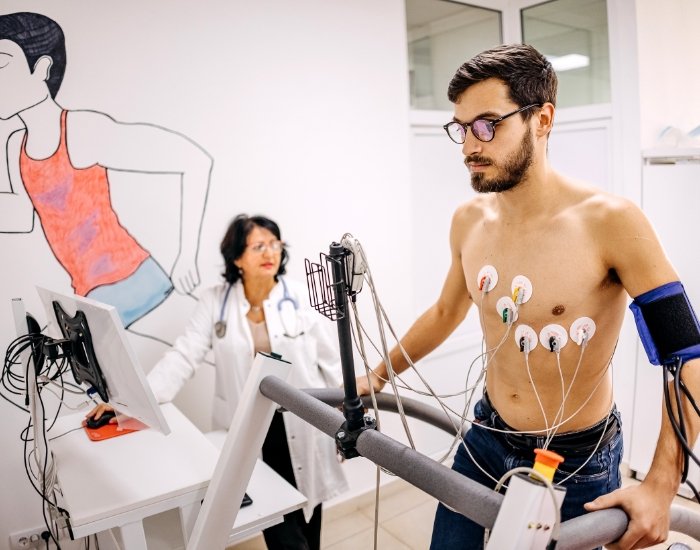
The evaluation usually includes an ECG, a wearable heart monitor to capture nighttime episodes, blood tests and, when needed, an echocardiogram or a sleep study.
- ECG: checks rhythm, rate and signs of strain. See ECG testing.
- Holter monitor (24–48 hours) or event monitor (up to 30 days): records your rhythm while you sleep. See Holter monitor.
- Blood tests: thyroid, electrolytes, blood count.
- Echocardiogram: looks at heart muscle and valves. See echocardiography.
- Sleep study: if snoring, pauses in breathing or daytime sleepiness suggest sleep apnea.
What Helps You Stop Noticing Your Heartbeat at Night?
Cutting late caffeine and alcohol, sleeping on your right side or back, staying hydrated, managing stress and treating any underlying condition usually help.
- Avoid caffeine after early afternoon and limit alcohol, especially before bed.
- Try sleeping on your right side or back if the left side makes the beat more noticeable.
- Stay hydrated and keep a normal intake of potassium-rich foods unless your doctor has restricted them.
- Use slow breathing (in for 4 seconds, out for 6) to calm an adrenaline surge.
- Ask your doctor or pharmacist whether any medicine you take can cause palpitations.
- If you snore heavily or stop breathing at night, ask about a sleep study.
If an arrhythmia is found, treatment ranges from reassurance to medicine, cardioversion or catheter ablation. Learn about atrial fibrillation and arrhythmia care.
Why Can I Hear My Heartbeat in My Ear at Night?
Hearing a whooshing or thumping in one ear when your head is on the pillow is called pulsatile tinnitus; it is often harmless but should be checked if it is new, one-sided or constant.
Pressing an ear into a pillow makes the blood flow in the nearby arteries and veins easier to hear, much like holding a seashell to your ear. Most people notice it only in that position and it stops when they turn over. That is normal.
Pulsatile tinnitus that you hear while upright, that affects only one ear, or that started suddenly deserves an evaluation. Causes range from earwax or fluid behind the eardrum to high blood pressure, anemia, an overactive thyroid and, rarely, narrowing of the carotid artery or abnormal blood vessels near the ear. Your primary care doctor or an ear, nose and throat specialist usually starts the workup; a cardiologist becomes involved when blood pressure, the carotid arteries or the heart rhythm are part of the picture. See carotid ultrasound.
Simple steps that often help
- Sleep with your head slightly raised on a firmer pillow.
- Use soft background noise, such as a fan, to mask the sound.
- Check your blood pressure at home for a week and share the readings with your doctor.
- Avoid caffeine and nicotine in the evening, since both make the pulse stronger.
Where to See a Cardiologist in Houston
Epic Heart & Vascular Center evaluates heart and vascular symptoms at three Greater Houston offices, with many tests such as ECGs and echocardiograms available on site. Care is led by Dr. M. Usman Khan, MD, FACC.
Also serving Richmond, Spring, Kingwood, Willowbrook and Eldridge patients. Monday to Friday, 8:00 am to 5:00 pm.
Key Takeaways
- Feeling your heartbeat when lying down, especially on your left side, is usually normal.
- A regular beat of 60 to 100 per minute with no other symptoms is reassuring.
- Caffeine, alcohol, stress, dehydration and some medicines are common triggers.
- Fast, irregular or pounding beats, or breathlessness lying flat, need a cardiology evaluation.
- An ECG and a heart monitor worn at night usually reveal the cause.
Frequently Asked Questions
Is it normal to feel your heartbeat when lying down?
Yes, it is common. Lying down increases blood return to the heart and brings it closer to the chest wall, and a quiet room makes each beat more noticeable.
Why do I feel my heart beat more on my left side?
Lying on your left side moves the heart closer to the chest wall, so the beat is easier to feel and sometimes hear.
When should I worry about feeling my heartbeat at night?
See a doctor if the beat is fast, irregular or very slow, if it wakes you, or if it comes with shortness of breath, chest pressure, dizziness or fainting.
Can anxiety make me feel my heart beating at night?
Yes. Anxiety raises adrenaline, which speeds and strengthens the heartbeat. A heart check is still wise if symptoms are new or frequent.
Can sleep apnea cause palpitations?
Yes. Repeated drops in oxygen during sleep trigger adrenaline surges and are linked to atrial fibrillation and other rhythm problems.
What test checks for palpitations at night?
A Holter monitor worn for 24 to 48 hours, or an event monitor worn for up to 30 days, records your heart rhythm while you sleep.
Sources and Further Reading
- National Heart, Lung, and Blood Institute. Arrhythmias: Symptoms.
- MedlinePlus. Heart palpitations.
- National Heart, Lung, and Blood Institute. Atrial Fibrillation.
- National Heart, Lung, and Blood Institute. Sleep Apnea.
- National Heart, Lung, and Blood Institute. Heart Failure: Symptoms.
Medical disclaimer: This article is for general education and does not replace a visit with your own doctor. Symptoms, test results and treatment choices differ from person to person.
Please note: Reading this article does not create a doctor–patient relationship. If you think you are having a medical emergency, call 911.

About our cardiology practice
Dr. M. Usman Khan, MD, FACC
Dr. Khan is an interventional and general cardiologist who leads care at Epic Heart & Vascular Center, with offices in Northwest Houston, Tomball and Sugar Land. He completed his cardiovascular fellowship at the University of Virginia and holds fellowships in the American College of Cardiology, the American College of Physicians, the Society for Cardiovascular Angiography and Interventions and the American Society of Nuclear Cardiology.
This guide was written by the Epic Heart & Vascular Center editorial team from the sources listed above. Meet Dr. Khan →
Related Articles
Heart Palpitations at Night: When to Worry and What You Should Know
Palpitations at night are common and often harmless, but some patterns point to atrial fibrillation, sleep apnea or other conditions. Learn the…
Heart Racing at Night: Causes of a Fast Heartbeat in Bed and What to Do
Waking with a racing heart can come from nightmares, anxiety, sleep apnea, low blood sugar, alcohol, thyroid problems or arrhythmias like SVT…
Heart Palpitations: Causes, When Your Heart Skips a Beat, and Treatment
Palpitations, the feeling that your heart is racing, pounding or skipping, are common and usually harmless. Learn the causes, warning signs of…