Epic Heart & Vascular Center · Tomball
Cardiac & vascular care on School Street in Tomball
Tomball, Spring and north Cypress patients see Dr. M. Usman Khan and his team for heart, artery and vein care, from chest discomfort and AFib to blood pressure that will not come down and leg pain with walking.
Tomball office
155 School St, Suite 220
Tomball, TX 77375
Monday to Friday, 8:00 am to 5:00 pm · (832) 304-2070
- Board-certified cardiologist
- Accepting new patients
- Referral fax (832) 626-7010
Dr. M. Usman Khan
MD, FSCAI, FACC, FACP, FASNC
Board-certified cardiologist
Meet Dr. M. Usman Khan, your Tomball cardiologist
Dr. Khan is an interventional and general cardiologist with more than 20 years of practice, caring for conditions of the heart, arteries and veins. He trained in cardiovascular medicine at the University of Virginia after residency at the University of Tennessee, graduated from King Edward Medical College in Lahore, holds board certifications in 5 specialties, and is a fellow of the American College of Cardiology, the American College of Physicians and the American Society of Nuclear Cardiology.
He explains each condition in plain language, along with the risks, benefits and alternatives of every option, so patients and families can take part in each decision. Dr. Khan speaks English, Urdu, Hindi and Punjabi, and his team also speaks Spanish.
Verified Google reviews
What our patients & families say
Rated 4.7 ★ across 562 Google reviews — practice-wide reviews for Epic Heart & Vascular Center across its Houston, Tomball and Sugar Land offices. Individual reviews are not tied to a specific office.
Reviews from Google · Read all reviews →
Cardiologist in Tomball, TX, on School Street
Dr. M. Usman Khan sees patients for heart and vascular concerns at Epic Heart & Vascular Center, 155 School St, Suite 220, Tomball, TX 77375. You can request a first cardiology visit, arrange follow-up after testing, or bring a referral from another clinician. When you call, tell us what prompted the appointment and whether anyone has already ordered a test. That helps us identify the visit you need and which records to look for.
Emergency? If you think you may be having a heart attack, call 911 now. New or ongoing chest pressure, particularly with shortness of breath, sweating, nausea, or pain spreading to the arm or jaw, can be an emergency. Do not wait for an office appointment.
Care led by Dr. M. Usman Khan, MD, FACC · Page updated November 2026
What we treat on School Street
- Coronary artery disease
- AFib & heart rhythm problems
- Heart failure
- High blood pressure
- Peripheral artery disease
- Varicose veins & venous insufficiency
- Carotid artery disease
- Aortic aneurysm
- Blood clots (DVT)
- Structural heart conditions (PFO, ASD)
What brings patients to a cardiologist?
Sometimes the reason fits on one line of a referral. A primary care clinician heard an irregular heartbeat, saw a change on an ECG, or wants advice about blood pressure that has been difficult to manage. Other times the reason is something you have noticed over several weeks. You might have to stop partway through a familiar walk or feel a flutter that disappears before you can describe it to anyone.
For a planned office visit, start with the change that matters to you. Tell us what you used to be able to do, what happens now, and whether it is getting more frequent. If your clinician sent you because of an abnormal result, the actual report is more useful than trying to recall every medical term. If you feel well and the concern was discovered during a routine visit, that is useful information too.
Dr. Khan is a board-certified cardiologist who practices general and interventional cardiology. His evaluations include problems involving the heart, arteries, and veins. The question at a first visit is often a practical one. Does the history and examination explain the concern, would an earlier result help, or is there a specific question another test could answer?
First visit, return visit, or follow-up after a hospital stay?
For a first appointment, the team needs the name of the referring clinician, if you have one, and a brief reason for the visit. Read the wording on the referral if you are unsure what was requested. A consultation for palpitations and an order for a particular heart monitor can involve different arrangements. If another Epic office has seen you before, mention which one so the team can locate the earlier visit.
For a return appointment, lead with what has happened since your last discussion. Perhaps a monitor was returned, a new medicine was prescribed by another doctor, or the symptom you were tracking has changed. If you are calling about a result, have the date and the name of the facility that performed the test. This gives the office a starting point even if the report has yet to arrive.
After a hospital stay, check your discharge paperwork for the recommended follow-up interval and the name of the clinician you were asked to see. Mention both when you call. Keep the discharge summary and the medication list from the hospital together. If the instructions name several specialists, ask which part of the plan the cardiology visit is meant to address.
Tomball office at a glance
Address
155 School St, Suite 220
Tomball, TX 77375
Office hours
Monday to Friday, 8:00 am to 5:00 pm
Phone
Referral fax
(832) 626-7010
How a Tomball cardiology visit works
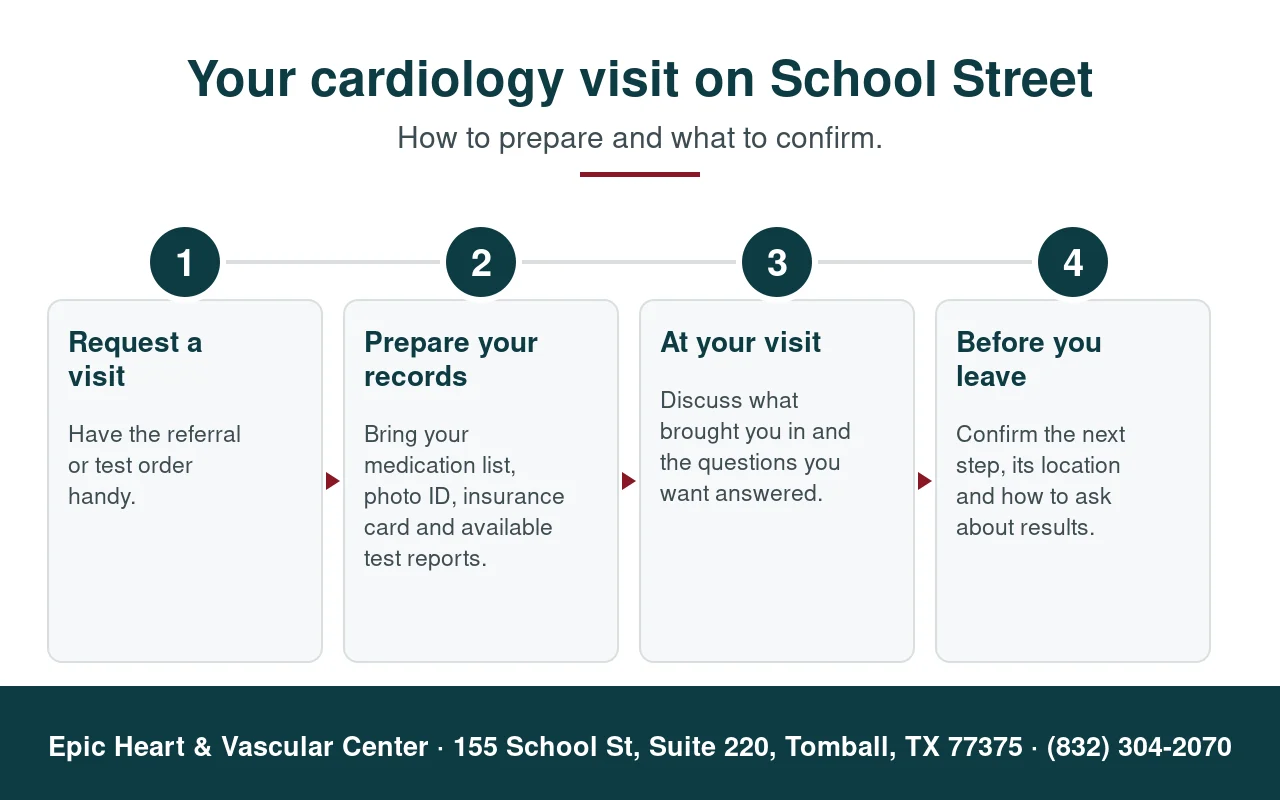
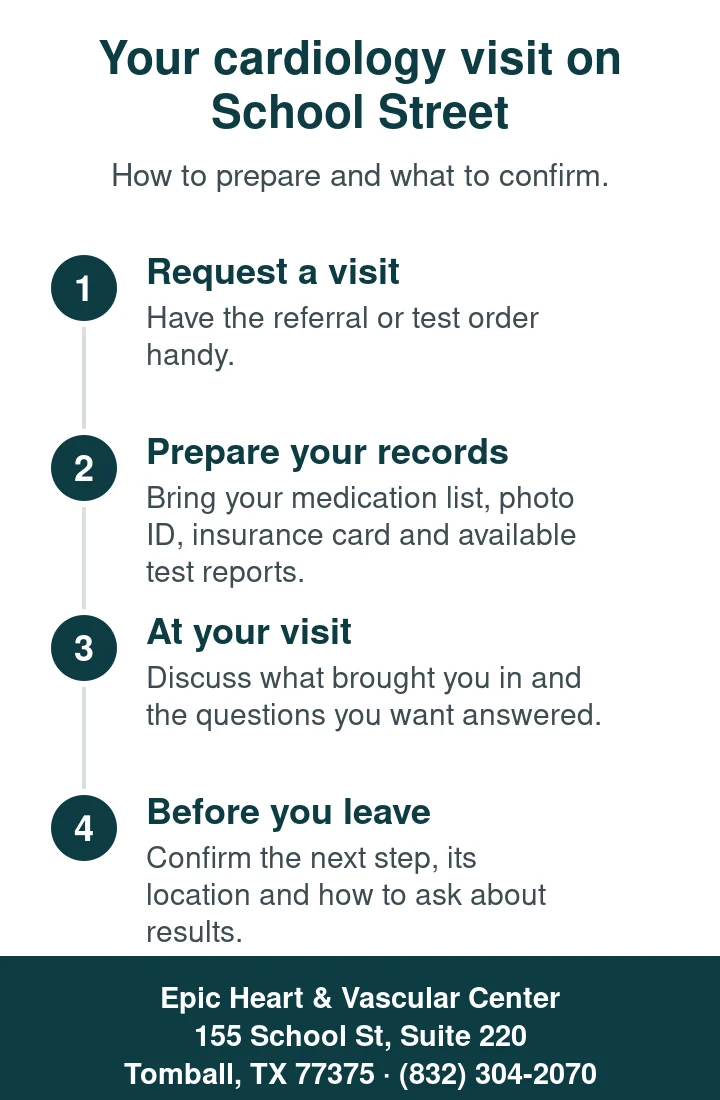
- Request the right appointment. Call (832) 304-2070 and ask for the Tomball office. Tell the scheduling team whether you are new to the practice, returning to review a result, or following up after a hospital visit. Ask for the date, time, and office address together, especially if you have also received care at another Epic location.
- Connect the referral and records. Your referring clinician can fax the referral and relevant records to (832) 626-7010. If several tests were performed, tell the team which facility has each report. For an ECG, ask whether the office needs the tracing along with the written interpretation. If your appointment is approaching, call to confirm what was received.
- Discuss the concern with your clinician. Bring your questions, your current medication list, and relevant reports you already have. Describe any symptoms in your own words. The clinician can review the timing, what brought them on, your medical history, and the findings on examination before discussing whether any testing or change in follow-up makes sense for you.
- Leave with the next step written down. If a test is recommended, ask what it is intended to clarify, where it will take place, and how you will learn the result. If another clinician is involved, ask which office is responsible for arranging the next appointment. Save the name and telephone number you will need if the instructions do not arrive as expected.
If your referral mentions palpitations or a heart monitor
A patient may notice a rapid or uneven heartbeat at home and feel fine again by the time of a scheduled appointment. Two details that help the discussion are how often this happens and roughly how long it lasts. An episode that happens during a particular activity gives your clinician a different starting point from a sensation you notice occasionally while sitting quietly. An approximate description is enough if you did not check the time.
An ECG records the heart’s electrical activity over a short period. A Holter monitor or another ambulatory monitor can record over a longer period when your clinician needs more information about the rhythm. If a monitor has already been ordered, bring the order or the ordering clinician’s contact information. Ask where the device will be fitted or delivered, who will explain its use, and which office will review the report after you return it.
If you have already worn a monitor, your most useful records include the dates you wore it and any report available to you. If a symptom occurred while you were wearing it, mention when it happened as closely as you remember. Your clinician can explain whether the recording included that period and what it shows in the context of your symptoms.
If the question is about walking discomfort or an artery test
A vascular referral sometimes starts with a change in an everyday activity. Perhaps discomfort in one calf makes you pause on the walk from your car, or a clinician examining your feet has asked you to have your circulation evaluated. Be ready to describe where you feel the discomfort, how far you can walk before it starts, what happens when you stop, and whether one side is more affected.
Leg symptoms can have several causes. The consultation gives your clinician a chance to compare your account with the examination and any earlier findings. Depending on the question, an ankle-brachial index or a vascular ultrasound may be discussed. An ankle-brachial index compares blood pressure at the ankle and arm. Ultrasound can provide information about blood flow in the vessels being examined. Your clinician can explain why one study might be useful in your situation.
An outside test report may contain the name of the artery or the side that was examined. Bring the full report when possible. If you were told to see a specialist after an imaging study, let the office know where the images are held. Before you travel for any procedure, confirm its location with the scheduling team. Your consultation in Suite 220 and a procedure ordered afterward can have different addresses.
Getting an outside report to the right clinician
When your primary care office sends a referral, it helps if the note states the question being asked. A blood pressure log with the dates and your usual medicines, for example, gives a cardiologist a more useful starting point than a single high reading recalled from memory. Bring any log you already keep and note if a reading was taken at home or in a clinician’s office.
If you have changed primary care practices or recently saw a specialist outside your usual health system, tell the Tomball team which clinician should receive follow-up information. Make a note of the practice name and phone number. At the end of your visit, ask whether the cardiology office will contact you directly with a result and when you should call if you have questions about the plan.
What can I check about cost before booking?
Use the member services number on your insurance card to check the physician, office, and service you intend to book. A benefit quote for an office visit covers a different question from a quote for a monitor or imaging study. If a test is recommended later, get its name and the facility where it will take place before checking benefits again. If you plan to pay directly, ask the scheduling team for an estimate of the consultation and what that estimate includes.
Planning your trip to Suite 220
Use the Tomball office address in your map app, including the suite number. Before leaving, compare the address with your appointment confirmation, particularly if you have a separate order for a test. If a family member is driving, send them the office address and the name Epic Heart & Vascular Center so you are both looking for the same destination.
For questions about the entrance, accessibility, or where a driver can drop you off, call the office before your visit. If you need language assistance or want a family member to join the discussion, ask about arrangements when you book. Having those details in advance leaves more of the appointment for the reason you came.
Tomball office
155 School St, Suite 220
Tomball, TX 77375
Office hours: Monday to Friday, 8:00 am to 5:00 pm
Phone: (832) 304-2070
Questions about scheduling and follow-up
Can I request a visit if I do not have a referral?
You can call to discuss an appointment. Whether a referral is required depends on your insurance plan and the service you need. Have your insurance card handy and ask about your particular plan for a visit with Dr. Khan at the Tomball location. Your insurer can confirm the requirements that apply to your coverage.
What should I bring if I take several medicines?
Bring a current list with each medicine’s name, dose, and how often you take it. Include over-the-counter products and supplements. If two lists from different offices disagree, bring both and point out the difference. Follow the instructions from your own care team for any visit or test preparation.
Is the test on my referral already scheduled?
A written order tells us which service was requested. Call to confirm that the team has the order and ask whether an appointment has been booked. Before heading out, make sure you have the facility name, address, date, and any preparation instructions for that specific test.
Can someone help me follow the discussion during the visit?
When you schedule, let the office know what would help you take part in the conversation. You may wish to bring a relative, have questions written out, or ask about language assistance. If someone else will call later about your results, ask the team how to document your permission.
Which number do I use for a Tomball appointment?
Call (832) 304-2070 for the Epic Heart & Vascular Center office at 155 School St, Suite 220, Tomball, TX 77375. If a clinician is sending a referral, give their office the referral fax number, (832) 626-7010. Mention your appointment date if you already have one so the team can match the records to your visit.
Request a visit at the Tomball office
For an appointment at the Tomball office, call (832) 304-2070. Tell the scheduler whether you are a new or returning patient and whether your doctor has sent a referral. If you think you may be having a heart attack or stroke, call 911.