Heart failure care has changed more in the past decade than in the thirty years before. Major cardiology societies, including the American Heart Association, American College of Cardiology and Heart Failure Society of America, publish guidelines that summarize the evidence and recommend how heart failure should be diagnosed and treated.
Guidelines are written for clinicians, but patients benefit from understanding them too. Knowing what treatments are recommended for your type of heart failure helps you ask the right questions and stay on therapies that can extend life. This guide translates the key points into plain language.
Quick answer
Current U.S. heart failure guidelines classify heart failure in stages A to D and by ejection fraction (reduced, mildly reduced or preserved). For heart failure with reduced ejection fraction (HFrEF), they recommend four foundational medicine classes: an ARNI, ACE inhibitor or ARB; an evidence-based beta-blocker; a mineralocorticoid receptor antagonist; and an SGLT2 inhibitor, started early and titrated to target doses. SGLT2 inhibitors are also recommended for mildly reduced and preserved ejection fraction. Devices, diuretics for congestion, treating causes and comorbidities, cardiac rehab and close follow-up complete care.
Have symptoms you want checked? Dr. M. Usman Khan sees patients at our Northwest Houston, Tomball and Sugar Land offices.
What patients say about our care team
Read all reviews on Google- ★★★★★
The staff was amazing, very friendly and attentive.
— Stephanie G. Google review - ★★★★★
He explained everything to me!
— Yesenia B. Google review - ★★★★★
Everyone is incredibly supportive and the standard of care is top tier.
— Humzah A. Google review - ★★★★★
It's always good when someone cares, not just comes to work.
— Cecila A. Google review - ★★★★★
I felt like I waited less time and was seen much faster!
— Yesenia B. Google review
- ★★★★★
I am extremely grateful for the support and compassion.
— Debra L. W. Google review - ★★★★★
She always takes great care of me.
— Shemeanna B. Google review - ★★★★★
Her clinical skills were exemplary. I would definitely recommend.
— Humzah A. Google review - ★★★★★
I had a great experience with my appointment today.
— Stephanie G. Google review - ★★★★★
Mrs. Maxine literally listened to my concerns.
— Cecila A. Google review
Important
Sudden severe breathlessness, chest pain, fainting or coughing pink frothy sputum need 911.
What Are the Stages of Heart Failure?
Stage A is at risk, Stage B is structural heart disease without symptoms, Stage C is heart failure with current or past symptoms, and Stage D is advanced heart failure.
| Stage | Description | Focus |
|---|---|---|
| A | At risk: hypertension, diabetes, obesity, family history | Prevention and risk-factor control |
| B | Pre-heart failure: structural changes or low EF, no symptoms | Medicines to prevent progression |
| C | Symptomatic heart failure | Full guideline-directed therapy |
| D | Advanced heart failure despite therapy | Advanced therapies, LVAD, transplant, palliative care |
What Are HFrEF, HFmrEF and HFpEF?
Heart failure is classified by ejection fraction: reduced (40% or less), mildly reduced (41% to 49%) and preserved (50% or more); an improved category describes patients whose EF has recovered above 40%.
Ejection fraction is measured on an echocardiogram. The category matters because the evidence for each medicine differs. See diastolic heart failure (HFpEF).
What Are the Four Pillars of HFrEF Treatment?
An ARNI (or ACE inhibitor or ARB), an evidence-based beta-blocker, a mineralocorticoid receptor antagonist and an SGLT2 inhibitor together reduce death and hospitalization substantially.
| Medicine class | Examples | Main benefit |
|---|---|---|
| ARNI / ACEi / ARB | Sacubitril-valsartan, lisinopril, losartan | Reduce strain, improve survival |
| Beta-blocker | Carvedilol, metoprolol succinate, bisoprolol | Slow heart rate, improve pumping |
| MRA | Spironolactone, eplerenone | Reduce scarring and fluid |
| SGLT2 inhibitor | Dapagliflozin, empagliflozin | Reduce hospitalization and death |
Guidelines emphasize starting these medicines early, often together, and increasing to target doses as tolerated rather than waiting months between changes.
What Do Guidelines Recommend for HFpEF?
SGLT2 inhibitors, diuretics for fluid, control of blood pressure, treatment of AFib, obesity, sleep apnea and diabetes, and exercise training; an MRA or ARNI may be considered in selected patients.
For people with obesity-related HFpEF, newer weight-loss medicines have shown improvement in symptoms and function in trials, and your cardiologist may discuss them. Treating the underlying conditions is central.
When Are Devices Recommended?
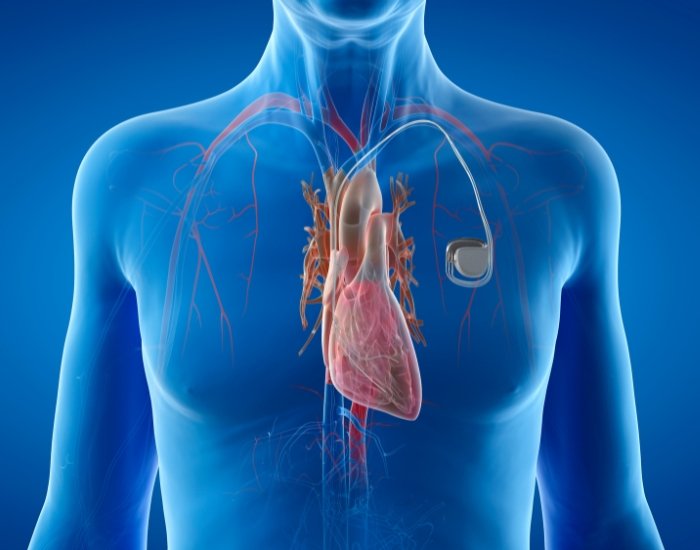
An ICD is recommended for many patients with EF of 35% or less despite therapy to prevent sudden death, and cardiac resynchronization therapy (CRT) helps selected patients with a wide QRS on ECG.
Other options include remote pulmonary artery pressure monitoring, transcatheter valve repair for severe mitral regurgitation, and LVADs for advanced disease. See biventricular pacemakers.
What Self-Care Do Guidelines Recommend?
Daily weights, recognizing worsening symptoms, taking medicines consistently, moderate sodium intake, regular physical activity or cardiac rehab, vaccinations, avoiding NSAIDs, and stopping smoking.
- Weigh yourself every morning; call for a gain of 2–3 pounds in a day or 5 pounds in a week.
- Follow a heart-healthy, moderate-sodium diet.
- Join cardiac rehabilitation when eligible.
- Stay current on flu, COVID-19 and pneumococcal vaccines.
- Avoid NSAIDs such as ibuprofen and naproxen unless your doctor approves.
- Limit alcohol and stop smoking.
When to seek care right away
Call 911 for:
- Severe breathlessness at rest
- Chest pain or pressure
- Fainting
- Coughing pink frothy sputum
Call your doctor the same day for:
- Weight gain of 2–3 lb in a day or 5 lb in a week
- Worsening swelling or breathlessness
- Needing more pillows to sleep
- Dizziness after a medicine change
How Often Should Heart Failure Be Followed Up?
Guidelines recommend a visit within about one to two weeks after hospital discharge and frequent visits during medicine titration, with repeat echocardiograms and lab checks of kidney function and potassium.
Close follow-up is when doses are optimized and problems caught early. A shared plan with your cardiologist reduces readmissions. See early signs of heart failure.
How Do Guidelines Recommend Diagnosing Heart Failure?
Diagnosis combines symptoms and examination with a natriuretic peptide blood test (BNP or NT-proBNP), an ECG, a chest X-ray and an echocardiogram, followed by tests to find the cause.
- BNP or NT-proBNP: helps confirm or rule out heart failure and tracks response.
- Echocardiogram: measures ejection fraction, valves and filling pressures.
- ECG: rhythm, prior heart attack, conduction delays relevant to CRT.
- Blood tests: kidney function, electrolytes, blood count, thyroid, iron studies, A1c and lipids.
- Cause testing: stress testing, coronary angiography or cardiac MRI when appropriate.
Finding and treating the cause
Guidelines stress identifying why heart failure developed. Coronary artery disease, uncontrolled hypertension, valve disease, persistent fast rhythms, alcohol, certain chemotherapy drugs, infiltrative diseases such as cardiac amyloidosis and genetic cardiomyopathies all have specific treatments. Fixing a correctable cause can sometimes reverse heart failure entirely.
Which Other Conditions Do Guidelines Say to Treat?
Guidelines recommend treating iron deficiency with intravenous iron in selected HFrEF patients, controlling atrial fibrillation, diabetes, hypertension and kidney disease, screening for sleep apnea and depression, and correcting significant valve disease.
| Condition | Why it matters | Typical approach |
|---|---|---|
| Iron deficiency | Worsens fatigue and exercise capacity | IV iron in selected patients |
| Atrial fibrillation | Worsens symptoms and stroke risk | Rate/rhythm control, anticoagulation, ablation |
| Diabetes | Speeds progression | SGLT2 inhibitors and glucose control |
| Sleep apnea | Strains the heart at night | Sleep testing and treatment |
| Mitral regurgitation | Adds volume load | Medicines, transcatheter or surgical repair |
Advanced heart failure and palliative care
When symptoms persist despite optimal therapy (Stage D), guidelines recommend timely referral to an advanced heart failure center to discuss LVAD or transplant, as well as palliative care to manage symptoms and align care with personal goals. Palliative care can be provided alongside active treatment, not only at the end of life.
What Questions Should You Ask Your Cardiologist?
Ask what type and stage of heart failure you have, your ejection fraction, whether you are on all four foundational medicines at target doses, whether you qualify for a device, and what your action plan is for worsening symptoms.
- What is my ejection fraction, and when will it be rechecked?
- Am I on all recommended medicines for my type of heart failure? If not, why?
- Are my doses at target, and what is the plan to get there?
- Do I qualify for an ICD, CRT or remote monitoring?
- What weight gain or symptoms should prompt a call?
- Am I eligible for cardiac rehabilitation?
- Which over-the-counter medicines should I avoid?
Bringing your medicine list, home weights and blood pressure readings to each visit makes these conversations faster and more productive. Ask about cost assistance if a recommended medicine is hard to afford; many options exist.
Do Guidelines Apply to Every Patient?
No. Guidelines summarize the best average evidence; your cardiologist adapts them to your kidney function, blood pressure, potassium, other conditions, preferences and goals.
Some patients cannot take every medicine or target dose. Shared decision-making ensures treatment fits your life while capturing as much benefit as possible.
Where to See a Cardiologist in Houston
Epic Heart & Vascular Center evaluates heart and vascular symptoms at three Greater Houston offices, with many tests such as ECGs and echocardiograms available on site. Care is led by Dr. M. Usman Khan, MD, FACC.
Also serving Richmond, Spring, Kingwood, Willowbrook and Eldridge patients. Monday to Friday, 8:00 am to 5:00 pm.
Key Takeaways
- Heart failure is staged A to D and classified by ejection fraction.
- HFrEF has four foundational medicine classes that reduce death and hospitalization.
- SGLT2 inhibitors are recommended across most ejection fraction ranges.
- ICDs and CRT help selected patients.
- Daily weights, rehab and close follow-up are part of guideline care.
Frequently Asked Questions
What are the current heart failure guidelines?
U.S. guidelines from the AHA, ACC and HFSA define stages A–D, classify by ejection fraction and recommend specific medicines, devices and self-care.
What are the four pillars of heart failure treatment?
An ARNI/ACE inhibitor/ARB, a beta-blocker, an MRA and an SGLT2 inhibitor for HFrEF.
Are SGLT2 inhibitors only for diabetes?
No. They benefit heart failure patients with or without diabetes.
Can heart failure improve?
Yes. With therapy, ejection fraction can improve, and medicines should usually continue.
How much salt should I have with heart failure?
Most patients are advised to avoid excess sodium; your doctor will set an individual target.
Who needs an ICD?
Many patients with EF of 35% or less despite optimal therapy, to prevent sudden cardiac death.
Sources and Further Reading
- Heidenreich PA, et al. 2022 AHA/ACC/HFSA Guideline for the Management of Heart Failure. PubMed.
- National Heart, Lung, and Blood Institute. Heart Failure.
- MedlinePlus. Heart failure.
- Centers for Disease Control and Prevention. Heart Failure.
Medical disclaimer: This article is for general education and does not replace a visit with your own doctor. Symptoms, test results and treatment choices differ from person to person.
Please note: Reading this article does not create a doctor–patient relationship. If you think you are having a medical emergency, call 911.

About our cardiology practice
Dr. M. Usman Khan, MD, FACC
Dr. Khan is an interventional and general cardiologist who leads care at Epic Heart & Vascular Center, with offices in Northwest Houston, Tomball and Sugar Land. He completed his cardiovascular fellowship at the University of Virginia and holds fellowships in the American College of Cardiology, the American College of Physicians, the Society for Cardiovascular Angiography and Interventions and the American Society of Nuclear Cardiology.
This guide was written by the Epic Heart & Vascular Center editorial team from the sources listed above. Meet Dr. Khan →
Related Articles

Early Signs of Heart Failure: What It Feels Like in the Early Stages
Early heart failure often feels like getting winded sooner, tiring faster and noticing swelling. Learn the 8 warning signs, when to call…
All You Need to Know About Diastolic Heart Failure (HFpEF)
Diastolic heart failure, or heart failure with preserved ejection fraction, happens when a stiff heart cannot fill properly. Learn the causes, symptoms,…

How Long Can You Live With a Biventricular Pacemaker?
Biventricular pacemakers (cardiac resynchronization therapy) help many heart failure patients live longer and feel better. Learn who benefits, what life expectancy depends…